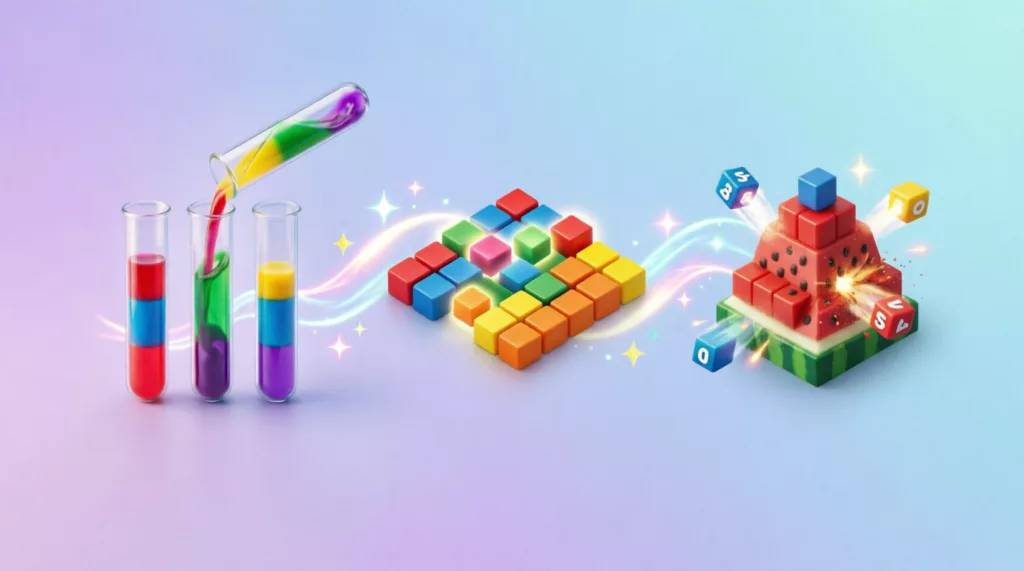
Few mechanics are as instantly satisfying as sorting a messy jumble of colors into neat, matching groups. Color sort puzzles have exploded in popularity because they’re easy to understand in seconds, but still leave room for real strategic thinking as levels get more complex. Here’s a full breakdown of how these games work, the different styles out there, and which ones are worth your time.
How Color Sort Puzzles Work
At their core, color sort puzzle games give you a jumbled arrangement of colored pieces — tiles, blocks, liquids, or shapes — and ask you to group matching colors together, usually with limited moves or limited space to work with.
The appeal is simple: visual clutter goes in, visual order comes out. That “before and after” satisfaction is a big part of why the genre has stuck around, but the actual challenge comes from constraints — you can’t always move a piece directly where you want it, so you have to plan a sequence of moves rather than just grabbing and sorting freely.
Types of Color-Based Puzzle Games
Classic Tube/Container Color Sort
The most common format: colored liquids or balls sit in narrow tubes or containers, and you pour or move them between containers until each one holds a single color. Simple rules, but the limited container space makes planning essential — pour into the wrong tube and you can block yourself in.
Tile-Matching Color Sort (Tile Sort Games)
Here, colors live on a grid of tiles instead of in containers. You slide, swap, or group tiles until matching colors sit together, often racing against the board filling up rather than a strict move limit. This is the format most people mean when they search for a tile sort game.
3D Color-Blast Puzzles
A newer twist on the genre takes color sorting into three dimensions. Instead of a flat grid or a row of containers, colors are part of a 3D structure, and you clear them by matching color-coded tools or blasters to the right section. Cube Land Puzzle Game is a good example of this style — it keeps the same color-matching logic but adds real depth to the puzzle, since clearing one color can open up access to blocks stacked behind it.
Best Color Sort & Color Matching Games to Try
Container/tube sorters — the purest, simplest version of the genre. Great for short sessions and for players who want a low learning curve.
Grid-based tile sorters — add a layer of spatial planning, since tiles need to be grouped rather than just poured. A good middle ground between simple and strategic.
Cube Land Puzzle Game — brings color sorting into a 3D voxel format, with color-matched blasters clearing sections of a cube structure. No timers, fully playable offline, and a slower pace than most reflex-driven color matchers.
Physics-based color droppers — colors fall or drop into place, and you arrange the board before it fills, blending color-matching with light physics-based strategy.
Bubble-style color poppers — a faster-paced cousin of the genre, matching clusters of colored bubbles or shapes for a quick, casual pop-and-clear loop.
Tips to Get Better at Color Sort Puzzles
- Plan two moves ahead, not just one — the obvious next move can sometimes block a better one later.
- Clear from the edges or outer layers first where possible, since interior pieces are often harder to reach later.
- Don’t rush partial matches — grouping “close enough” colors early can trap you later when you need that space.
- Look for chain opportunities — in games with cascading clears, one well-placed move can trigger several matches at once.
FAQ
What is the goal of a color sort game? The goal is typically to group all matching colors together — whether that’s colors in separate containers, tiles on a grid, or sections of a 3D structure — usually within a limited number of moves or a limited amount of space.
Are color sort games good for the brain? Color sort puzzles engage pattern recognition and forward planning, since most levels require you to think a few moves ahead rather than sort colors at random. They’re a low-pressure way to exercise that kind of sequential thinking, especially in versions without a timer.
Curious what color sorting looks like in 3D? Cube Land Puzzle Game brings the same color-matching logic to a voxel cube format — free to download, no timers, fully playable offline.