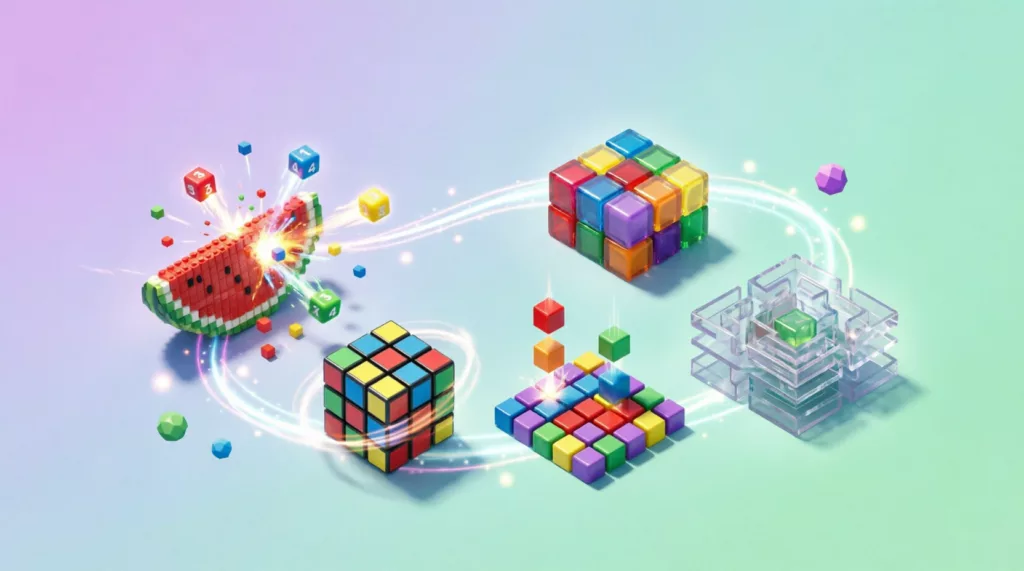
Flat, grid-based puzzles have been the backbone of mobile gaming for years — but a newer wave of games is adding real depth, literally. 3D and voxel-style puzzle games take the same satisfying “clear the board” logic everyone loves and stack it into structures you have to think about from every angle. If you’ve been sticking to 2D block puzzles, this list is worth a look.
What Makes a Puzzle Game “3D” (Not Just Visually)?
Plenty of games use 3D-looking graphics on top of a flat, 2D puzzle — nice lighting and shading, but the actual logic is still row-and-column. A genuinely 3D or voxel puzzle game is different: the structure itself has depth, and that depth changes the puzzle. Blocks can be stacked, hidden behind others, or dependent on what’s cleared around them first.
A few signs a puzzle game is “3D” in a way that actually matters:
- You can rotate or view the structure from multiple angles
- Clearing one section affects what’s accessible in another
- Blocks are made of individual voxels (small cube units) rather than flat tiles
- The puzzle has genuine spatial planning, not just color matching
That distinction matters if you’re specifically looking for something more challenging than a flat grid.
Top 3D Puzzle Games to Play Right Now
1. Cube Land Puzzle Game
Cube Land builds every level as a 3D voxel cube structure, cleared by aiming color-matched blasters at matching sections. Because the structure has real depth, clearing one part can open up — or complicate — access to blocks stacked behind or beneath it. There’s no timer and no forced ad breaks between moves, and the whole game is playable offline, which makes it an easy pick-up-and-put-down game rather than something that demands your full attention on a schedule.
2. Isometric block stackers
This style presents puzzles from a fixed isometric angle, giving a strong sense of depth without needing to rotate the camera. Popular for puzzles that involve gravity and stacking logic, where removing a lower block can cause a structural collapse above it.
3. Rotating cube puzzles
These games let you spin the entire puzzle structure to view and solve it from any angle. They tend to lean more toward classic spatial-reasoning puzzles — closer to a digital Rubik’s-style challenge than a casual clearer.
4. 3D match-and-clear games
A more casual and approachable take on the genre, using familiar match-three or match-four logic on a 3D grid rather than a traditional flat board. These games often add light physics, allowing cleared blocks to visibly fall, tumble, or shift into new positions and create fresh matching opportunities.
5. Physics-based voxel destruction games
These emphasize the “destruction” side of voxel puzzles — dramatic chain reactions, collapsing structures, and satisfying cascading clears triggered when you remove a single key supporting block. The challenge often lies in identifying the right block to target, then watching your carefully planned move bring the entire arrangement tumbling down.
6. Layered maze-style 3D puzzles
Less about clearing pieces and more about careful navigation, these puzzles challenge you to discover a workable path through a complex 3D structure, often moving between multiple stacked layers, interconnected floors, or hidden routes.
7. Minimalist voxel art puzzles
A quieter, more contemplative corner of the genre, these games focus on simple, low-poly voxel aesthetics paired with slow, meditative puzzle pacing. Rather than emphasizing fast clearing mechanics or constant pressure, they encourage careful observation, thoughtful decisions, and a relaxed sense of progression.
3D vs. 2D Puzzle Games — Which Should You Choose?
2D puzzle games tend to be faster to learn, quicker to play in short bursts, and easier to pick up if you’re new to the genre. The logic is usually simpler: rows, columns, straightforward matches.
3D puzzle games ask for a bit more spatial thinking, but reward it with puzzles that feel more physical and less like a spreadsheet. They’re a good fit if you’ve mastered flat grid puzzles and want something with more depth — literally and mechanically.
Neither is objectively better; it depends on whether you want a quick, simple session or something that makes you pause and actually study the structure before you move.
FAQ
What are voxel puzzle games? Voxel puzzle games are built from small 3D cube units (voxels) rather than flat 2D tiles. This gives the puzzle real depth — blocks can be stacked, hidden, or interdependent — instead of everything sitting on a single flat plane.
Are 3D puzzle games harder than 2D ones? Generally, yes, at least in terms of spatial reasoning. You have to consider depth and what’s hidden behind or beneath visible blocks, not just what’s directly in front of you. That said, most 3D puzzle games still ease players in with simple early levels.
What are the best free 3D puzzle games for Android and iOS? Cube Land Puzzle Game is a strong starting point if you want voxel-based clearing with no timers and full offline play. From there, it’s worth trying a couple of the other styles above — isometric stackers, rotating cube puzzles — to see which spatial logic you enjoy most.
Want to try the voxel puzzle style for yourself? Cube Land Puzzle Game is free, works offline, and has no timers to rush you through a level.